
Wrong platform choice
Going native when cross-platform would do — or the reverse — doubles cost or caps what the app can ever do.

We build native and cross-platform mobile applications for Android and iOS that combine performance, usability, and the features your users actually need — delivered on time and built to scale.
Native vs Cross-Platform
Whether you need a customer-facing mobile app, an internal tool for your field team, or a marketplace application — the right technology choice depends on your performance requirements, budget, and target platform.
We build native Android (Kotlin) and iOS (Swift) applications when performance, hardware integration, or platform-specific UX is critical. For projects that require both platforms with faster delivery, we use Flutter or React Native for cross-platform development without compromising on quality.
Every mobile app we deliver is tested on real devices, optimized for performance, and submitted to both Google Play Store and Apple App Store by our team.
ANDROID
Kotlin
Native Android development for Google Play Store
iOS
Swift
Native iOS development for Apple App Store
CROSS-PLATFORM
Flutter
Single codebase for Android & iOS
CROSS-PLATFORM
React Native
JavaScript-based cross-platform mobile apps
Business Challenges
Most failed apps share the same three root causes, and all of them are decidable up front.
Going native when cross-platform would do — or the reverse — doubles cost or caps what the app can ever do.
Privacy declarations, permissions and review guidelines are handled at submission instead of during design.
Apps that assume connectivity break in exactly the environments where field teams use them.

Our Solution
We pick the platform strategy against your feature list and budget, design for the network conditions your users really have, and treat store compliance as a build requirement.
Native or cross-platform chosen against your feature requirements, timeline and long-term maintenance cost.
Local storage, queued actions and conflict resolution so the app keeps working on a weak connection.
Permissions, privacy labels, data-safety declarations and review guidelines built into the design phase.
A shared API layer so Android and iOS stay in step rather than drifting apart release by release.
Mobile App Capabilities
Features & Deliverables
Signed release builds, store listings, screenshots and submission handled end to end.
Phone, email or social sign-in with OTP, plus a first-run flow designed to reduce drop-off.
Segmented and transactional push wired through FCM and APNs with delivery reporting.
Local persistence and background sync so records created in the field are never lost.
Screen, event and funnel tracking so you can see where users stop.
Versioning, staged rollout, crash reporting and a documented update process.
Our Process
Detailed requirements analysis, platform strategy (native vs cross-platform), feature scope, and technical architecture planning.
Platform-native design guidelines (Material Design / Apple HIG), wireframes, interactive prototypes, and user testing.
Agile development with continuous real-device testing, API integration, performance optimization, and QA.
Store submission, compliance review, launch support, crash monitoring, and ongoing feature updates.
Business Benefits
Where cross-platform fits, a single codebase halves ongoing maintenance without capping the roadmap.
Offline-first behaviour keeps field, shop floor and travelling teams productive on poor connections.
Compliance handled during design means submissions clear review instead of bouncing.
Related platform work
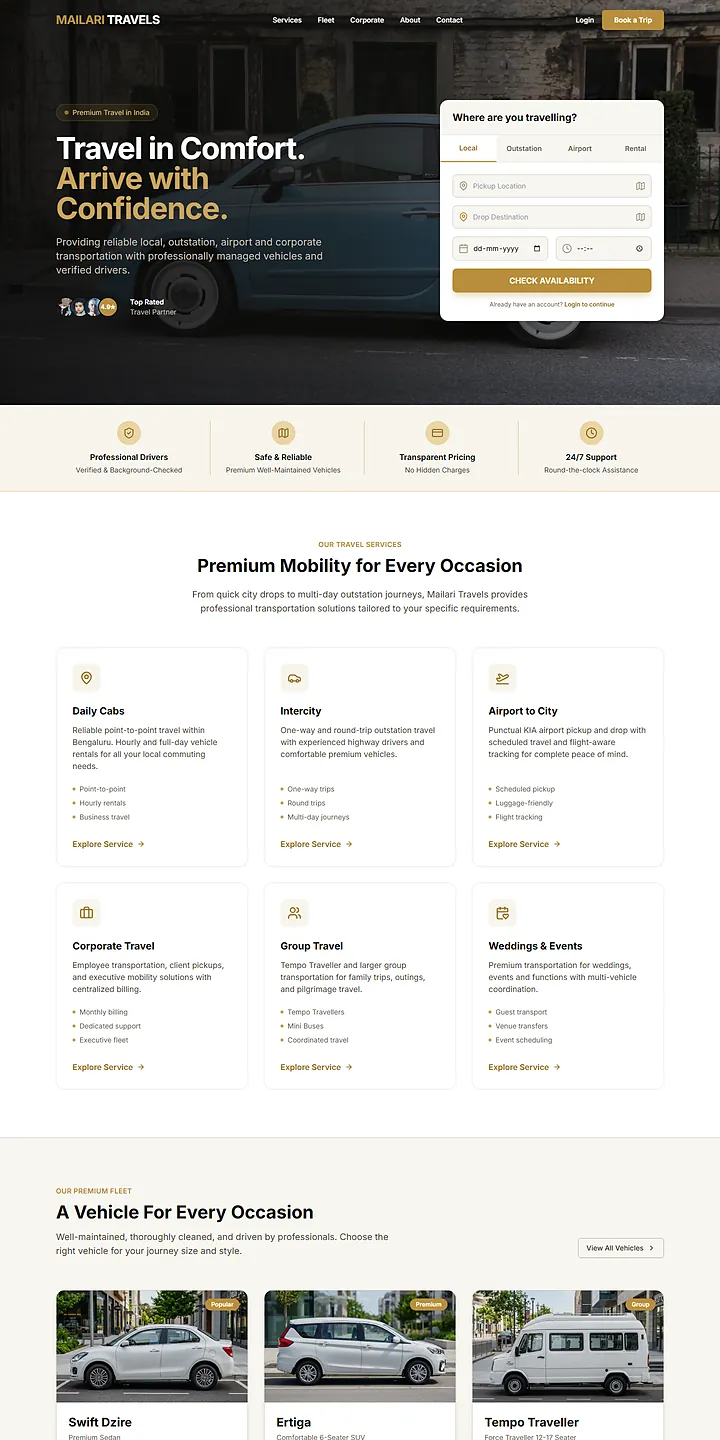
Our named, linkable work in this area is a web platform rather than a native app. It is shown here because the problems it solves — booking, accounts, dispatch — are the same ones a mobile build would.
Travel in comfort, arrive with confidence
Mailari Travels runs local, outstation, airport and rental journeys, and also carries corporate accounts. Those are two different audiences arriving at the same site — one booking a single trip, one arranging recurring business transport.
FAQ
Related Services
Multi-tenant products with subscription billing and cloud infrastructure.
Explore serviceFast, accessible, conversion-focused websites and web applications.
Explore serviceWorkflow automation and AI that removes repetitive manual work.
Explore serviceShare your app idea and we'll help you define the right platform, architecture, and feature set to get to market.